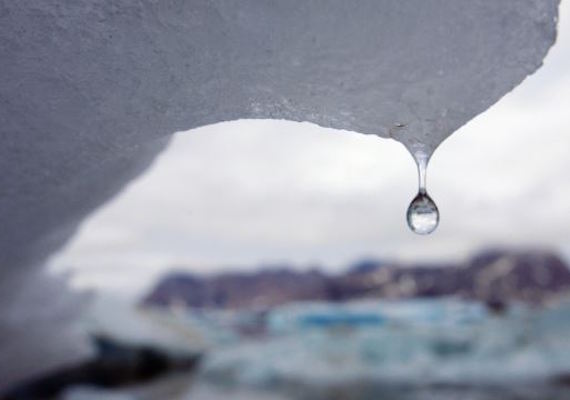
Scientists found sea levels are rising faster today than anytime over the past 3,000 years. Another group of scientists found that January temperatures in the Arctic hit a record high. The sea level researchers gathered information going back 28 centuries. Their findings were released Monday by the Proceedings of the National Academy of Sciences. Robert Kopp, from Rutgers University in New Jersey, is the paper’s lead author. He said the 20th century rise was “extraordinary” when compared to the past 3,000 years. And, Kopp said, “the rise over the last two decades has been even faster.” When temperatures rise, so do sea levels. That is because snow and ice melt, or break off from glaciers. They flow into the sea. The increased water makes the sea levels rise. The best estimates show that temperatures around the Earth have risen more than a half-degree Celsius since 1880.
What does glacier mean?
to speed up
involving the entire world
a large area of ice that spreads out over land
cannot be avoided
What also rises when the temperatures rise?
sea level
pollution
unemployment
littering
January temperatures in the Arctic hit a record high.
south
Arctic
sea
America