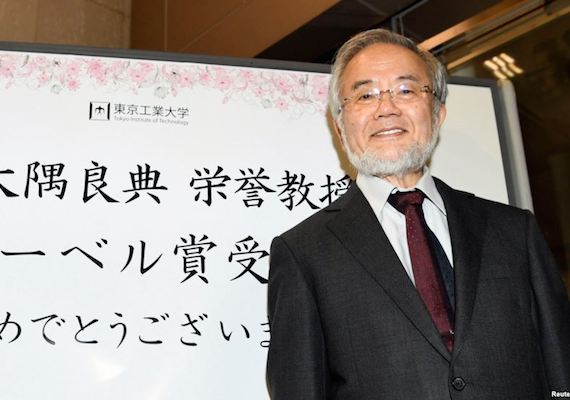
Yushinori Ohsumi of Japan has won the 2016 Nobel Prize in Physiology or Medicine. The Nobel Assembly at Sweden’s Karolinska Institute announced the prize on Monday. The institute is honoring Ohsumi for his experiments with baker’s yeast in the 1990s. He studied a natural process in which cells break down and reuse some of their parts. This process is called autophagy. The word autophagy comes from two words in the Greek language. They are “auto-,” meaning “self,” and phagein, meaning “to eat.” The prize committee said understanding the science behind this process has led to a better understanding of diseases such as cancer, Parkinson’s and type 2 diabetes. The Karolinska Institute said, “His discoveries opened the path to understanding the fundamental importance of autophagy in many physiological processes.”
What does physiology mean?
the science of how things move
a science that deals with the way living things work or operate
the science of studying water
the science of studying animals
Which product did Ohsumi experiment with which lead to his discovery?
bakers yeast
milk
bread
cat food
He studied a natural process in which cells break down and reuse some of their parts.
mold
insects
cells
blood