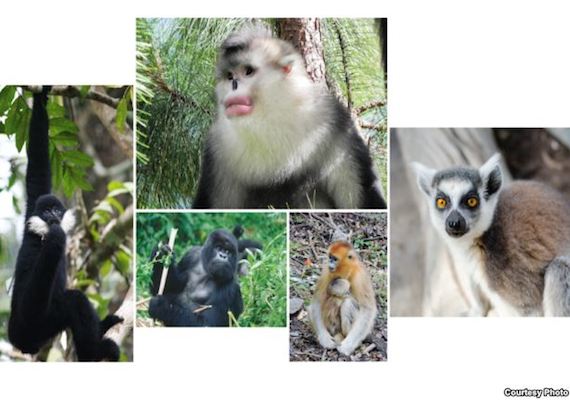
Scientists who study primates say that we are moving towards a time when species like gorillas will no longer be found in the wild. They say Orangutans would be gone too. And Madagascar would lose its lemurs. Jo Setchell is a primatologist at Durham University in Britain. She studies primates, the group of mammals that includes gorillas, chimps, monkeys, gibbons, mandrills, and lemurs. And, of course, humans. So If we have 60 percent threatened with extinction at the moment, then we will see that number rise and within our lifetimes, within our children's lifetimes, we will eradicate other primates. In all, there are an estimated 600 different species of primates. They include the little creature called the mouse lemur, whose body is only about six centimeters long. Then, there is the largest of the species, the gorilla, weighing up to 250 kilograms. Primates face one common threat: loss of habitat, the places in nature where they live. Primatologists like Setchell say human activity is to blame.
What does eradicate mean?
increase numbers
human activity
eliminate or destroy
damage habitat
What is causing primate extinction?
new research
human activity
fake news
global warming
There are an estimated six hundred different species of primates.
two hundred
six thousand
six hundred
sixty