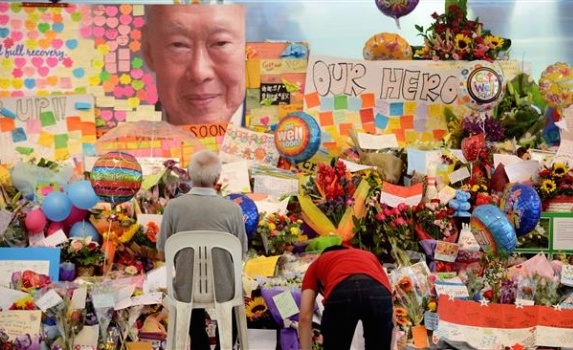
Former Singapore Prime Minister Lee Kuan Yew died early Monday. He was 91 years old.
Mr. Lee was Singapores leader from 1959 until 1990. In recent years, he remained a highly influential person in the city-state, off the coast of Malaysia.
The president of the United States offered his sympathy to the Lee family. President Barack Obama described Lee Kuan Yew as a "visionary" who built "one of the most prosperous countries in the world today."
Mr. Obama said the former leader was "a true giant of history who will be remembered for generations to come as the father of modern Singapore and as one the great strategists of Asian affairs."
Chinese President Xi Jinping praised Mr. Lee as an old friend of the Chinese people who was respected by the international community as a strategist and a statesman.
Harry Lee Kuan Yew was a fourth generation Singaporean. His ancestors moved there from Chinas Guangdong Province in the 1860s.
Mr. Lee was a survivor of the Japanese occupation of Singapore during World War II. After the war, he studied economics in London, and received a law degree from Cambridge University.
His political life began in 1954 with the formation of the Peoples Action Party, also known as PAP. The group represented a coalition of middle class parties and trade unionists.
In 1955, Lee Kwan Yew was the opposition in the legislature. But disagreements within the PAP led to arrests of pro-communist members two years later.
The PAP won elections in 1959, with Mr. Lee becoming Singapores first Prime Minister. He held the position until 1990, when he became a senior minister.
Political scientist Carl Thayer is with the University of New South Wales in Australia. He says the appointment of Lee Kwan Yew was important to Singapores future.
The story of modern day Singapore cant be told without reference to Lee Kuan Yew. He took the country from colonial rule to independence. He fended off challenges from the socialist left and then he dominated politics.
One of Mr. Lees early goals was to form a Federation of Malaysia, bringing together Singapore, Malaya, Sabah and Sarawak. But he had differences with the leader of Peninsular Malaysia, Tunku Abdul Rahman.
Historians say Mr. Lee disagreed with Mr. Abdul Rahmans support for local Malays over the areas ethnic Chinese. The Chinese and Muslims clashed in 1964 and again in 1965. After the unrest, Mr. Abdul Rahman called for the separation of Malaysia from Singapore.
At the age of 42, Lee Kuan Yew became the leader of the city-state. He began working in support of Singapores most valuable resource its people. Foreign investment followed. With economic growth of near 10 percent for many years, Singapore helped define economic development for Asian Tigers such as Hong Kong, Taiwan and South Korea.
Michael Barr is a political scientist at Flinders University in South Australia. He says that as Singapore industrialized, it rose as a modern city-state.
Singapore became a center for transportation, oil refining and finance. It developed a world famous national airline. It also was the worlds busiest seaport until recently when Shanghai was recognized as the busiest.
Michael Barr says Mr. Lee also brought together administrators to shape Singapores future.
He brought serious political leadership and political mass to what was a group of strong-minded and imaginative men and competent administrators. And without his political leadership would not have been able to establish the political hegemony that they have been able to.
Some critics use the word authoritarianism to describe Lee Kuan Yews actions and position toward his opponents. The government used the Internal Security Act to detain opposing politicians, activists and trade unionists.
In 1963, the government arrested 100 people, including Said Zahari, a newspaper editor who was held for 17 years without trial.
In 1987, the government detained 22 Roman Catholic Church officials, social activists and professionals. The government accused them of a left wing conspiracy. When local and foreign media criticized the action, Lee Kuan Yew brought a case against the media in Singapores courts.
Whoever governs Singapore must have that iron in him or give it up. This is not a game of cards. This is your life and mine," he said. "Ive spent a whole life in building this and as long as I am in charge nobodys going to knock it down.
Singapore remains a country where the government exercises tight controls over free speech. In 2014, Reporters without Borders rated Singapore among the lowest countries in Southeast Asia for press freedoms, behind Myanmar, Cambodia, Thailand and Indonesia.
I'm Mario Ritter.