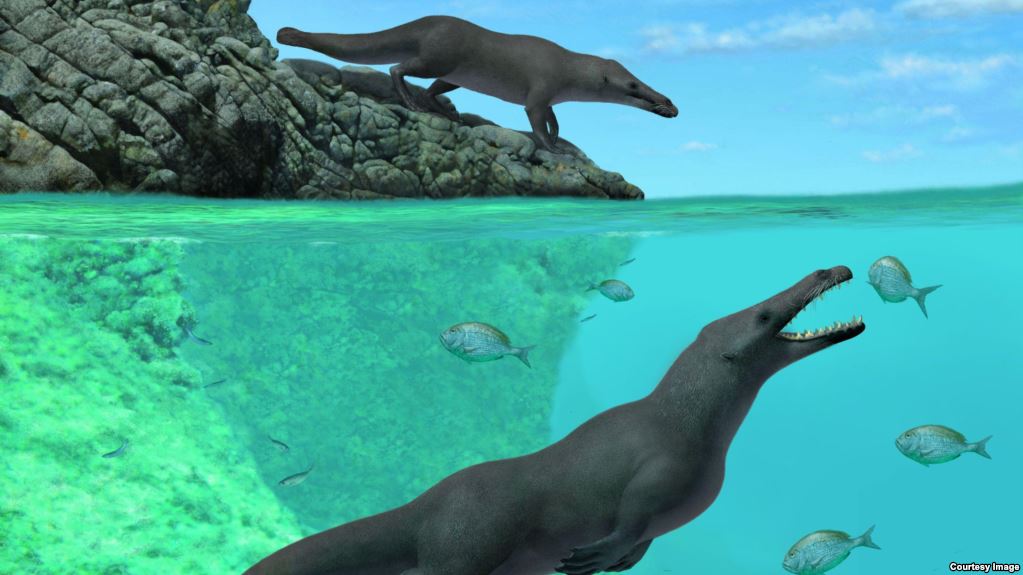
The whales we know today are large, fish-like animals that only live in the sea. But the ancestors of these underwater creatures had legs to carry them on land. Now, scientists working in South America have reported the discovery of fossils of a four-legged whale. The scientists believe it lived about 43 million years ago. They say the find is important to helping understand the evolution and movements of these early whales. Paleontologists reported on the discovery in the publication Current Biology. They wrote that a research team discovered the fossils eight years ago in a coastal desert area of southern Peru. Scientists have been studying them and putting together the skeleton. The four-legged whale is called Peregocetus pacificus, which in Latin means “the travelling whale that reached the Pacific Ocean.” It was an ancestor of whales that were amphibious, having the ability to live both on land and in water.
What is a fossil?
a grocery bag
a breed of cat
part of an animal or plant from thousands of years ago, preserved in rock
a traditional holiday meal
They say the find is important to helping understand the evolution and movements of these early what?
whales
insects
computers
people
Scientists have been studying them and putting together the skeleton.
hard drive
engine
puzzle
skeleton