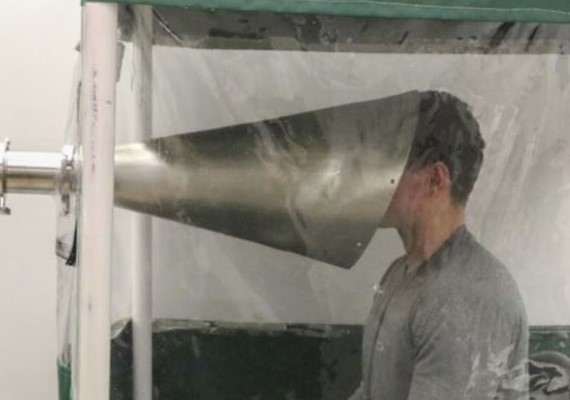
At a university in the United States, people infected with the new coronavirus are part of an experiment. The subjects put their faces into the big end of a large cone-shaped device. They then say the alphabet and sing or just sit quietly for half an hour. The cone captures everything that comes out of their mouths and noses. The device is helping researchers study a big question: Exactly how does the virus that causes COVID-19 spread? The Associated Press recently reported on the study at the University of Maryland. The coronavirus has been known to link up with small liquid particles released by an infected person. People expel particles when coughing, sneezing, singing, talking, and even breathing. But these droplets come in any number of sizes. The University of Maryland researchers are attempting to identify how risky the different sizes are. Since the early days of the COVID-19 pandemic, public health officials have been concerned about larger particles from the coronavirus. But some scientists are now studying smaller particles, the ones that spread like cigarette smoke. These particles, called aerosols, can stay in the air for minutes to hours. They can spread throughout a room and build up if air ventilation is poor.
What is ventilation?
a system or means of providing fresh air
the process of testing a vaccine
the method of casting a vote
a system of water pipes
Where is the study featured in this article being conducted?
University of Maryland
Center for Disease Control
Harvard University
The World Health Organization
The small particles being studied are called aerosols.
aerosols
lenses
agents
rocks