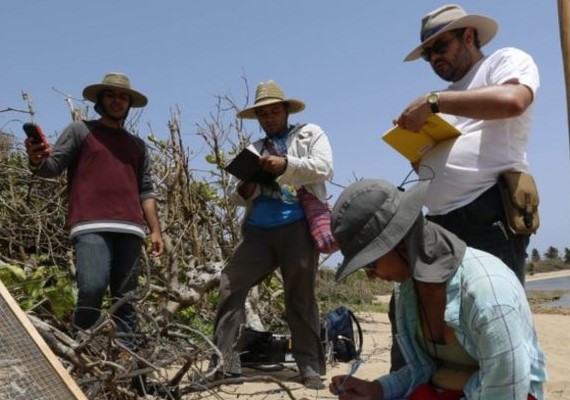
A group of scientists is hurrying to document ancient ruins on the U.S. territory of Puerto Rico. The sites, along Puerto Rico’s coast, date back a few thousand years. The scientists are working as fast as they can before rising sea levels destroy a large part of the island’s history. Scientists hope to use the three-dimensional (3D) images they have taken to help identify which sites are most at-risk to natural disasters and other dangers. Falko Kuester is director of the Cultural Heritage Engineering Initiative at the University of California, San Diego. He said, “A big part of what we’re working on is to make the invisible visible and make sure it stays in our memory.” The university, known as UCSD, is involved in the research project. Also involved are its Scripps Institution of Oceanography and Para la Naturaleza, an environmental group based in Puerto Rico. The work started in August 2017. Scientists first explored a large stretch of land along Puerto Rico’s north coast. That area includes a ceremonial center used by the Taino Indians about 2,000 years ago, said Isabel Rivera Collazo. Rivera is an environmental archaeologist at UCSD and directing the project. She said the scientists found what appears to be a large settlement just east of the ceremonial site. It was discovered with help from drone aircraft and other technology, including 3D images. She added that scientists were also able to map out the shape of the ceremonial site.
What does 3D stand for?
three dimensional
three degrees
thermal imaging
those dudes
Why are the historical sites in danger?
because of rising sea levels
because of boycotts
because of lack of interest
because of protests
Scientists are hurrying to document ancient ruins in Puerto Rico.
Puerto Rico
Saint Croix
Bahamas
Bermuda