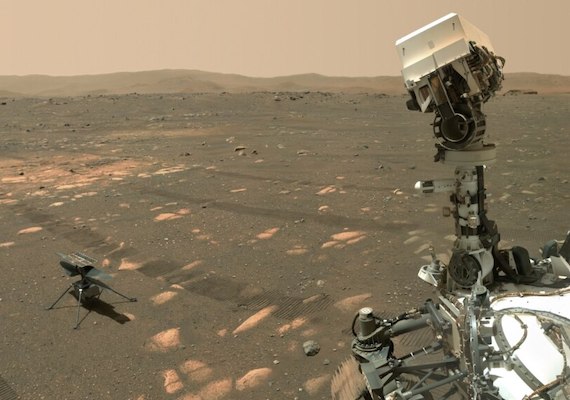
The U.S. space agency’s explorer, Perseverance, arrived on Mars on February 18 with an important piece of equipment. NASA’s Perseverance was carrying an experimental aircraft called Ingenuity, which is set to have its first test flight this week. NASA hopes to make the helicopter the first vehicle to fly on a planet other than Earth. NASA recently announced that Ingenuity had been safely lowered onto the surface of Mars from its storage space underneath Perseverance. The explorer, or rover, then moved about five meters away from Ingenuity. The rover and aircraft are communicating through radios. After separating from the rover, the helicopter faced its first important test on Mars -- protecting itself from the planet’s freezing temperatures. Readings taken from instruments on Perseverance from early April showed low temperatures at the landing area, called Jezero Crater, had reached minus 83 degrees Celsius. In a statement, NASA said Ingenuity passed the test by surviving its first night alone in the extreme cold. The helicopter used its own solar-powered battery to operate a heater to protect its electrical equipment from damage. The space agency praised the success as “a major milestone” for the experimental aircraft.
What does solar-powered mean?
Using power sourced directly from sunlight
Using power sourced directly from the wind
Using the power of song to charge a battery
Using water to power an engine
What is the name of NASA's experimental aircraft that was carried by Perseverance?
The Eagle
Ingenuity
Independence
Steve
NASA hopes to make the helicopter the first vehicle to fly on a planet other than Earth.
Earth
Venus
Saturn
The Moon