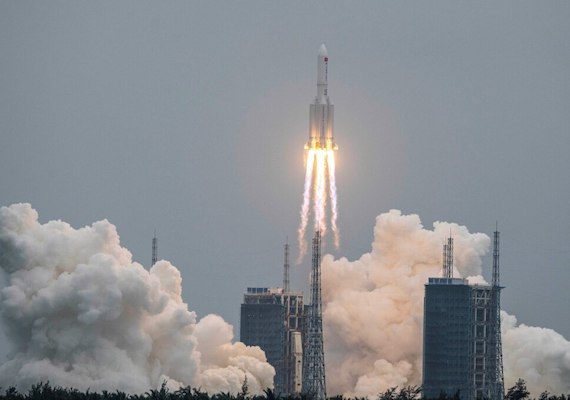
China says it has successfully launched the first part of a planned new space station it aims to complete by the end of 2022. State media reported the module was carried to space Thursday by a Long March 5B rocket. It was built to house Chinese astronauts during stays of up to six months. The module is called Tianhe, which means “Harmony of the Heavens” in Chinese. It is one of three main parts China plans to use to build its first self-developed, permanent space station. Chinese officials have said 11 space missions will be necessary to complete the space station, which will orbit Earth at an altitude of 340 to 450 kilometers. China’s President Xi Jinping praised the launch as “an important pilot project in the building of a powerful nation in both technology and in space,” state media reported. China aims to become a major space power by 2030. It has been expanding its space program in recent years, with successful crewless missions to the moon and Mars. In December, China landed its third spacecraft on the moon and said the vehicle successfully collected material from the lunar surface. The country also has a spacecraft orbiting Mars that is expected to land on the planet around the middle of next month. Currently, the only other space station in service is the International Space Station (ISS). It is backed by the United States, Russia, Europe, Japan and Canada. China was banned from taking part in ISS operations by the United States.
What is a mission?
An important project or trip
A type of spacecraft
The act of listening
A collection of data
What planet has China had successful manless missions to?
Mars
Venus
Jupiter
Krypton
It is backed by the United States, Russia, Europe, Japan and Canada.
New Jersey
Canada
Brazil
India