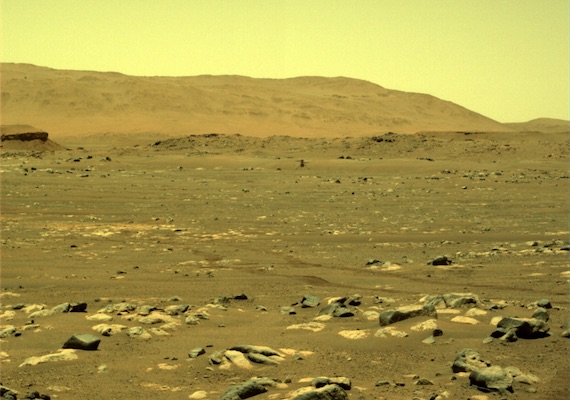
A new study suggests icy clouds above early Mars could have provided the warmth to permit flowing water on the Red Planet. American researchers used a computer model to predict that icy clouds in the Mars atmosphere may have created a greenhouse effect. Earth also experiences a greenhouse effect, which happens when gases in the atmosphere trap in heat from the sun. Today, Mars enjoys a cold, desert climate. Any existing water is believed to be in the form of ice because of the planet’s extremely cold temperatures. There is, however, a rich amount of evidence suggesting that rivers, lakes and even oceans once existed on Mars. In fact, scientists announced in February they had created a new map designed to identify the best sources of water ice on Mars. Scientists have long sought to explain what made it possible for Mars to have the large rivers and lakes they believe existed in the planet’s ancient past. Researchers involved in the latest study were interested in coming up with a possible explanation. They created a three-dimensional, or 3D, model of the Martian atmosphere. The study was led by Edwin Kite, a professor and planetary scientist at the University of Chicago. He said the research resulted in a major discovery that ice on the surface of Mars likely caused the greenhouse effect. The study was recently published in Proceedings of the National Academy of Sciences.
What is a climate?
The weather conditions prevailing in an area in general or over a long period
The day-to-day changes in rain or sunshine
Relating to the biodiversity of a planet
Someone who scales mountain tops
What likely caused the greenhouse effect on Mars?
Ice
Methane
Plutonium
Aliens
There is, however, a rich amount of evidence suggesting that rivers, lakes and even oceans once existed on Mars.
oceans
mammals
swamps
dinosaurs