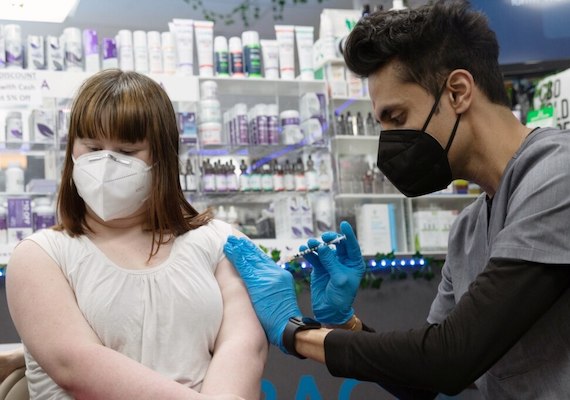
As more Americans are being vaccinated, more people say they are now willing to get the shots than in January. However, questions about side effects and how the shots were tested still hold some people back. This presents a challenge for U.S. health officials who are ready to expand vaccination to children as young as 12 years old. The AP-NORC survey, released Tuesday, found 1 in 5 American adults now say they probably or definitely will not get vaccinated. In January, when the shots were first given out, opinion researchers found about 1 in 3 said that they would not get vaccinated. African Americans are becoming more open to the shots, with 26 percent now saying they definitely or probably will not get vaccinated compared with 41 percent in January. That is similar to the 22 percent of Hispanic Americans. Among Asian Americans, just nine percent said they definitely or probably will not get the shots. The U.S. Centers for Disease Control and Prevention says that more than 150 million people about 58 percent of all adults have received at least one dose of a vaccine. Among those who remain unvaccinated, only 34 percent of people in the study say they definitely will not get the shot. About three-fourths of those who said they are unlikely to get vaccinated have little to no confidence that the vaccines were tested enough. Some 55 percent were very concerned about side effects. The numbers, however, mean a large number of unvaccinated Americans could be persuaded to get the shots. Kizzmekia Corbett is an immunologist with the National Institutes of Health. Corbett helped lead development of the Moderna shot. She spends hours giving answers to questions from Americans especially African Americans like her. Her job is to fight against misinformation about the three vaccines approved for emergency use in the U.S. She tells people the COVID-19 vaccines will not cause inability to bear children. Also, the speedy development of vaccines does not mean they are less safe, Corbett told the AP.
Title: More Americans Willing to Get Vaccine, Now Open to Children
Content: <div id='article-page'><div id='article-content' data-media-url='//news-app-staging.s3.amazonaws.com' data-base-url='//news-app-staging.herokuapp.com' data-sound-name='https://news-app-production.s3.amazonaws.com/articles/5073/C.wav' data-capture-url='//staging.analytics.lingraphica.com/events/capture_news' data-article-title='More Americans Willing to Get Vaccine, Now Open to Children' data-article-id='5640'><script src='//news-app-staging.herokuapp.com/javascripts/getscripts.js'></script><link rel='stylesheet' href='//news-app-staging.herokuapp.com/stylesheets/article.css' type='text/css' /><div class='article'><p><span data-start-time='0' data-end-time='9063'>As more Americans are being vaccinated, more people say they are now willing to get the shots than in January.</span> <span data-start-time='9063' data-end-time='17542'>However, questions about side effects and how the shots were tested still hold some people back. </span> <span data-start-time='17542' data-end-time='28938'>This presents a challenge for U.S. health officials who are ready to expand vaccination to children as young as 12 years old.</span> <span data-start-time='28938' data-end-time='43250'>The AP-NORC survey, released Tuesday, found 1 in 5 American adults now say they probably or definitely will not get vaccinated. </span> <span data-start-time='43250' data-end-time='54521'>In January, when the shots were first given out, opinion researchers found about 1 in 3 said that they would not get vaccinated.</span> <span data-start-time='54521' data-end-time='68708'>African Americans are becoming more open to the shots, with 26 percent now saying they definitely or probably will not get vaccinated compared with 41 percent in January.</span> <span data-start-time='68708' data-end-time='73813'>That is similar to the 22 percent of Hispanic Americans. </span> <span data-start-time='73813' data-end-time='82542'>Among Asian Americans, just nine percent said they definitely or probably will not get the shots.</span> <span data-start-time='82542' data-end-time='98000'>The U.S. Centers for Disease Control and Prevention says that more than 150 million people about 58 percent of all adults have received at least one dose of a vaccine.</span> <span data-start-time='98000' data-end-time='108354'>Among those who remain unvaccinated, only 34 percent of people in the study say they definitely will not get the shot. </span> <span data-start-time='108354' data-end-time='119271'>About three-fourths of those who said they are unlikely to get vaccinated have little to no confidence that the vaccines were tested enough. </span> <span data-start-time='119271' data-end-time='125208'>Some 55 percent were very concerned about side effects.</span> <span data-start-time='125208' data-end-time='134271'>The numbers, however, mean a large number of unvaccinated Americans could be persuaded to get the shots.</span> <span data-start-time='134271' data-end-time='140208'>Kizzmekia Corbett is an immunologist with the National Institutes of Health. </span> <span data-start-time='140208' data-end-time='145792'>Corbett helped lead development of the Moderna shot. </span> <span data-start-time='145792' data-end-time='155563'>She spends hours giving answers to questions from Americans especially African Americans like her. </span> <span data-start-time='155563' data-end-time='165792'>Her job is to fight against misinformation about the three vaccines approved for emergency use in the U.S.</span> <span data-start-time='165792' data-end-time='173583'>She tells people the COVID-19 vaccines will not cause inability to bear children. </span> <span data-start-time='173583' data-end-time='183354'>Also, the speedy development of vaccines does not mean they are less safe, Corbett told the AP.</span> </p></div><div class='control-buttons-sticky' style='display:none;'><div class='control-buttons'><button title='Back' class='back' disabled='disabled'></button><button title='Play' class='play' disabled='disabled'></button><button title='Pause' class='pause' style='display:none;'></button><button title='Forward' class='forward' disabled='disabled'></button><button class='finished-reading' style='display:none;'>Done</button></div></div></div><div id='article-media'><div id='media-image'><img src='https://news-app-production.s3.amazonaws.com/articles/5073/C.jpeg'/></div></div><div id='question-content' style='display:none;'><div class='vocabulary_question question-container' data-question-id=17422 data-hint-location='82542' style='display:none;'><div class='question' data-sound-name='https://news-app-production.s3.amazonaws.com/articles/5073/what_is_a_dose.wav'>What is a dose?</div><div class='choices' data-correct-choice='The amount of a medicine, drug or vitamin that is taken at one time'><div class='choice' data-sound-name='https://news-app-production.s3.amazonaws.com/articles/5073/the_amount_of_a_medicine_drug_or_vitamin_that_is_taken_at_one_time.wav'><span>The amount of a medicine, drug or vitamin that is taken at one time</span></div><div class='choice' data-sound-name='https://news-app-production.s3.amazonaws.com/articles/5073/to_have_carried_out.wav'><span>To have carried out</span></div><div class='choice' data-sound-name='https://news-app-production.s3.amazonaws.com/articles/5073/a_female_deer.wav'><span>A female deer</span></div><div class='choice' data-sound-name='https://news-app-production.s3.amazonaws.com/articles/5073/an_entire_bottle_of_a_medicine_before_it_is_split_up.wav'><span>An entire bottle of a medicine before it is split up</span></div></div></div><div class='multiple_choice_question question-container' data-question-id=17423 data-hint-location='155563' style='display:none;'><div class='question' data-sound-name='https://news-app-production.s3.amazonaws.com/articles/5073/how_many_vaccines_are_approved_for_emergency_use_in_the_us.wav'>How many vaccines are approved for emergency use in the U.S.?</div><div class='choices' data-correct-choice='3'><div class='choice' data-sound-name='https://news-app-production.s3.amazonaws.com/articles/5073/3.wav'><span>3</span></div><div class='choice' data-sound-name='https://news-app-production.s3.amazonaws.com/articles/5073/2.wav'><span>2</span></div><div class='choice' data-sound-name='https://news-app-production.s3.amazonaws.com/articles/5073/4.wav'><span>4</span></div><div class='choice' data-sound-name='https://news-app-production.s3.amazonaws.com/articles/5073/0.wav'><span>0</span></div></div></div><div class='sentence_completion_question question-container' data-question-id=17424 data-hint-location='173583' style='display:none;'><div class='question' data-sound-name='https://news-app-production.s3.amazonaws.com/articles/5073/also_the_speedy_development_of_vaccines_does_not_mean_they_are_less__blank__corbett_told_the_ap.wav'>Also, the speedy development of vaccines does not mean they are less <span class='blank'>safe</span>, Corbett told the AP.</div><div class='choices' data-correct-choice='safe'><div class='choice' data-sound-name='https://news-app-production.s3.amazonaws.com/articles/5073/safe.wav'><span>safe</span></div><div class='choice' data-sound-name='https://news-app-production.s3.amazonaws.com/articles/5073/dangerous.wav'><span>dangerous</span></div><div class='choice' data-sound-name='https://news-app-production.s3.amazonaws.com/articles/5073/valuable.wav'><span>valuable</span></div><div class='choice' data-sound-name='https://news-app-production.s3.amazonaws.com/articles/5073/potent.wav'><span>potent</span></div></div></div><div class='question-buttons'><button class='skip-button'></button><button class='hint-button'></button><button class='speak-button'></button></div></div></div>
Sound Name: https://news-app-production.s3.amazonaws.com/articles/5073/C.wav
Preview