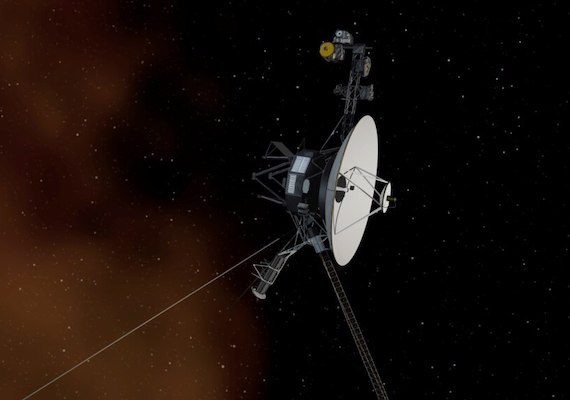
Scientists say NASA’s most distant exploring spacecraft has recorded what they describe as ‘humming’ beyond our solar system. A new study suggests the continuous hum, detected by the Voyager 1 spacecraft, is caused by waves existing in interstellar space. Voyager 1 left our solar system eight years ago, crossing the border that divides our solar system from interstellar space. “Interstellar” means “between stars.” Scientists say interstellar space begins where the sun's continual flow of material and its magnetic field stop. Researchers say instruments on Voyager 1 identified the waves as vibrations in small amounts of gas found in the near-emptiness of interstellar space. The vibrations are also known as plasma waves. The spacecraft detected the waves over several years at different radio frequencies. Results from Voyager 1’s findings were recently published in a study appearing in Nature Astronomy. Astronomers believe the space that Voyager 1 is passing through -- known as the interstellar medium -- is filled with different kinds of waves, both big and small. Such waves can provide information about the density of the interstellar medium. The new research was led by Stella Ocker, a doctoral student at New York’s Cornell University and a member of NASA’s Voyager 1 team. She was able to make the discovery by examining data slowly sent back by Voyager 1 from about 23 billion kilometers away.
What does interstellar mean?
Between stars
Inside a star
Outside a black hole
Beyond Earth's atmosphere
Which spacecraft detected the hum?
Voyager 1
Voyager 2
The Eagle
Curiosity Rover
The spacecraft detected the waves over several years at different radio frequencies.
digital
radio
high-pitched
delta