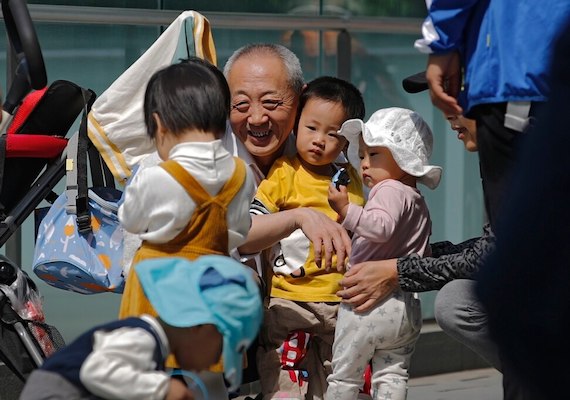
China’s government has raised the child limit for couples from two to three as the country experiences lower birth rates. For many years, China enforced a one-child policy as a way to control the population. But that policy was replaced in 2016 with a two-child limit. That change was aimed at raising the number of births as the country faced a fast aging population. But birth rates have further decreased in recent years as the cost of raising children in Chinese cities remains high. The latest measure to permit three children per family is meant “to actively deal with the aging population,” the official Xinhua News Agency reported. The decision came during a ruling Communist Party meeting led by President Xi Jinping, it said. The policy includes what the government calls supportive measures” to make it easier for families to have more children. The measures include plans to lower educational costs for families and increase tax and housing support. The government also said it would seek to educate young people on marriage and love. Recent data showed that China’s fertility rate -- the average number of births per mother -- was 1.3 in 2020. That rate which is similar to aging nations like Japan and Italy is well short of the 2.1 needed to replace the population. Yifei Li is a sociologist at New York University Shanghai. She told Reuters that most families did not hold back on having children in recent years because of the government’s two-child policy. Instead, she said they held off because of "the incredibly high costs of raising children in today's China.” Zhang Xinyu is a 30-year-old mother of one from Zhengzhou in northeastern China. She said another problem was that women carried most of the responsibility for raising children. She added, “I don't want to have a second child. And a third is even more impossible." Economists say that China, along with Thailand and some other Asian economies, faces concerns that it could grow old before it gets wealthy. The Chinese population of 1.4 billion was already expected to reach a high later this decade before starting to drop. But recent government data suggested that is happening faster than expected. Experts say this adds to pressures on underfinanced retirement and health systems and cuts the number of future workers available to support a growing retiree group.
What is a policy?
A course or principle of action adopted or proposed by a government, party, business, or individual
The civil force of a national or local government, responsible for the prevention and detection of crime and the maintenance of public order
A strange or peculiar person, thing, or trait
A flat, rounded candy on the end of a stick
How many children can couples have in China according to the new regulations?
Three
Two
One
Unlimited
The Chinese population of 1.4 billion was already expected to reach a high later this decade before starting to drop.
workforce
military
debt
population