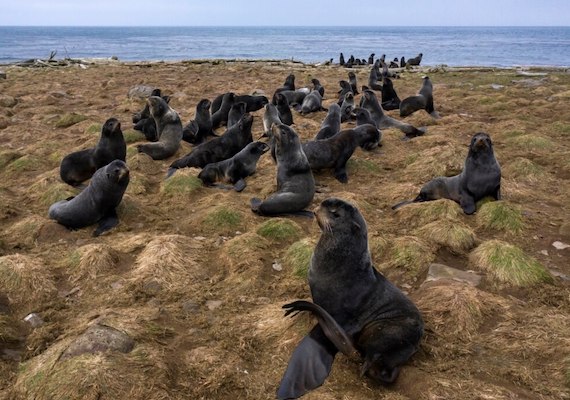
Fifty years ago, Patrick Pletnikoff spent his summers cutting fat off dead seals during Alaska’s yearly harvest. He competed with other young men to show who had the fastest knife. Today, he is fighting to protect the small remaining population of seals. He is hoping to create Alaska’s first marine sanctuary in the nearby waters. The creation of a protected area would give native people the power to limit fishing of the seals’ prey the fish the seals eat. Commercial seal hunting was once the economic driver of St. George, a small island far from the Alaskan mainland. But the native Unangan community has struggled to find a new trade in the years since hunting seals was banned. There are now less than 60 people left on the island. Pletnikoff is 73 years old. He is the island’s long-serving mayor. He has spent years pushing the federal government to add St. George as a U.S. marine sanctuary. He hopes such an act would start a new "conservation economy" on the island, one that is based on environmental tourism, scientific research and responsible fishing. It could be a new beginning, Pletnikoff said of his plan for the island. St. George and nearby St. Paul are sometimes called the Galapagos of the north for their rich wildlife in the northern Pacific. Pletnikoff said he has a responsibility “to our environment and the animal kingdom as well. Generations of Unangan people worked in hard conditions in the seal trade. The trade was first run Russian explorers and then the U.S. government. But now the U.S. government is aiming to give local people more power over their land and water - including powers to control fishing. U.S. President Joe Biden has promised to expand ocean protections as part of his efforts to fight climate change.
What is a sanctuary?
the floor of a building which is partly or entirely below ground level
an area of open land, especially one planted with crops or pasture
a place of refuge or safety
a deep, wide ditch surrounding a castle, fort, or town, typically filled with water
In which state is the island of St. George?
Maine
Alaska
California
Texas
U.S. President Joe Biden has promised to expand ocean protections as part of his efforts to fight climate change.
bears
hunger
climate change
fires