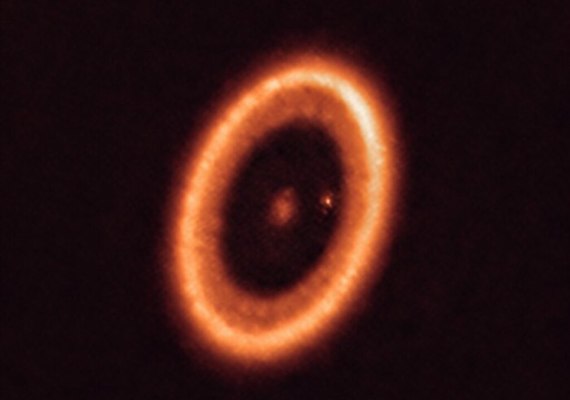
Scientists say they have clearly identified for the first time a moon-forming area around a planet beyond our solar system. The ring-shaped area surrounds an exoplanet called PDS 70c. An exoplanet is a planet that orbits a star outside our solar system. The identified region is known as a circumplanetary disk. This is an area surrounding a planet where moons and other satellite objects can form. The disk is made up of gas and dust. Researchers from the ALMA observatory, which operates from Chile’s Atacama desert, made the discovery. ALMA is the largest radio telescope in the world. Astronomers had previously found signs of moon-forming disks around this exoplanet and others. They say, however, that in the past they were not able to clearly differentiate the disk from the surrounding environment. The team says the new finding may help scientists better understand how moons and planets form in young star systems. The results were recently published in a study in The Astrophysical Journal Letters.
What is a disk?
a French pizza
the bottom part of a pencil
a shape or surface that is round and flat in appearance
an unmanned vehicle
What is the term for a planet that orbits a star outside our solar system?
extra credit
comet
exoplanet
meteor
ALMA is the largest radio telescope in the world.
bean
dancer
tree
telescope