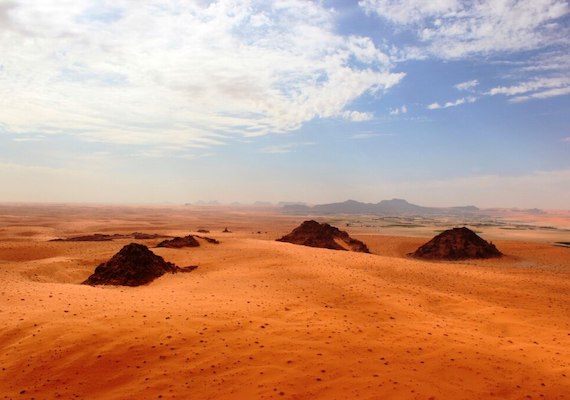
New evidence suggests that the desert of the Arabian Peninsula once had water and plants that brought early humans and large animals from Africa. Until 10 years ago, scientists trying to rebuild the story of early human movements out of Africa knew little about the Arabian Peninsula. Much more is known about early human settlements in the Levant region. The Levant is the area that includes modern-day Israel, Jordan, Lebanon and parts of Syria. Archaeological research has been carried out there for more than one hundred years. But a recent study published in Nature suggests that the Arabian Peninsula may have served as a bridge between Africa and Eurasia. Michael Petraglia is one of the writers of the study. He is an archaeologist at the Max Planck Institute for the Science of Human History in Jena, Germany. The research team included scientists from Germany, Saudi Arabia, Australia, Britain and other countries. He said, “Arabia has not been part of the story of early human migration because so little work was done there before.” Huw Groucutt is also based at the Max Planck Institute. He travels to archaeological places in the northern Arabian Peninsula where rolling sand dunes, or hills, extend as far as the eye can see. Scientists started to look closely for archeological remains in the region after satellite images showed signs of prehistoric lakes in the areas that are now desert. “We noticed color patterns made by ancient lakes sand dunes are kind of orange-colored, while ancient lakes are tinted white or gray,” said Groucutt. Over the past 10 years, archeologists have found stone tools from several periods of prehistoric settlement by early human groups. The oldest was from 400,000 years ago.
What is a peninsula?
a piece of land almost surrounded by water or projecting out into a body of water
an instrument for writing or drawing with ink, typically consisting of a metal nib or ball, or a nylon tip, fitted into a metal or plastic holder
a paste of ground roasted peanuts, usually eaten spread on bread
an antibiotic or group of antibiotics
Which two areas does the study suggest the Arabian Peninsula was a bridge for?
Africa and Eurasia
Africa and Greenland
Ireland and England
Africa and India
The research team included scientists from Germany, Saudi Arabia, Australia, Britain and other countries.
tweezers
kaleidoscopes
scientists
recipes