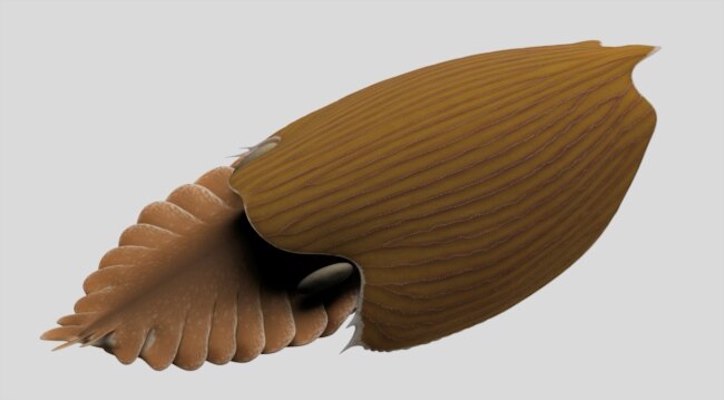
About 506 million years ago, a strange sea creature swam in warm waters on the ocean floor off the coast of present-day Canada. At that point in time, it was one of Earth's largest hunters. Titanokorys gainesi or Titanokorys, for short is an arthropod from the Cambrian geological period. Titanokorys lived during a time when much of present-day North America was below warm seas. On September 8, scientists announced the discovery of its fossils in the Canadian Rockies. The area where it was found is known to be rich in Cambrian fossils. The name Titanokorys means titanic helmet -- and for good reason. Titanic means very large. Helmet is a hard hat you wear on your head. And this creature's “helmet” or head shell made up about two-thirds of its 50-centimeter-long body. While that may not sound very big, during the Cambrian Period it was huge. Most other life forms were smaller than a human thumbnail at that time. By comparison, Titanokorys was longer than an adult human forearm,” said Jean-Bernard Caron. He is a paleontologist of the Royal Ontario Museum in Toronto. He is also the lead writer of the study that appeared in the publication Royal Society Open Science. He and his team spoke with Reuters news agency about their discovery. Caron said in its day, Titanokorys was a “giant.” It was also a very strange looking animal. He added, “it could be compared to a giant swimming head since the body was so short …” The creature was also flat, so it could live on the sea floor. The eyes of the Titanokorys had many different moving parts. Its circular mouth was lined with triangular tooth-like structures. It had two claws to capture prey. It had gills and a series of flaps on the sides of its body for swimming. Scientists think the Titanokorys fed on buried prey like worms. It used its claws to dig in the mud to find food. However, its claws did not pick up the prey; instead, they pulled the prey into the mouth.
What does titanic mean?
very large
somewhat blue
covered in ice
from Mars
Where was the fossil discovered?
The Great Salt Lake
Mexico City
The Canadian Rockies
The Mariana Trench
It had gills and a series of flaps on the sides of its body for swimming.
dancing
swimming
typing
flying