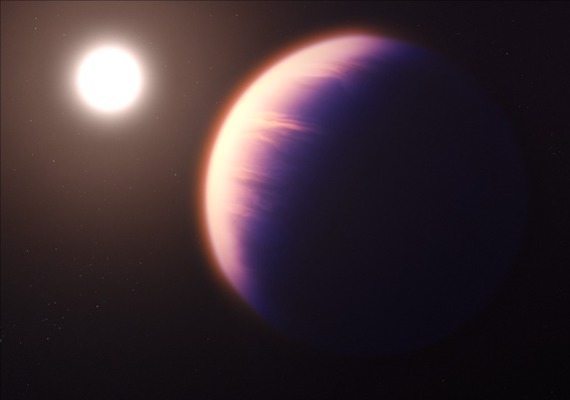
The newly deployed James Webb Space Telescope has discovered the first clear evidence of carbon dioxide in the atmosphere of a planet outside our solar system. The American space agency NASA confirmed the evidence, which it said was discovered in the atmosphere of a planet orbiting a star about 700 light years from Earth. Planets that orbit a star outside our solar system are called exoplanets. NASA said the exoplanet where the carbon dioxide was found, or detected, is a hot, gas planet. It was discovered in 2011 and is called WASP-39 b. The exoplanet which has a mass about the same as Saturn’s stays around 900 degrees Celsius. It remains hot because it orbits very close to its star. The space agency said the Hubble and Spitzer space telescopes have made observations of WASP-39 b in the past. Those observations suggested the presence of water vapor, sodium and potassium in the exoplanet’s atmosphere. But now, the presence of carbon dioxide has also been confirmed in its atmosphere. NASA said the Webb telescope was able to make the discovery because of its unusual technical abilities. Researchers recently described the discovery in a paper published online. A detailed study about the findings is to appear in an upcoming issue of the publication Nature.
Which of the following is a definition of the word exoplanet?
a planet that orbits a star outside the solar system
a large public exhibition of art or trade goods
a journey or voyage undertaken by a group of people with a particular purpose, especially that of exploration, scientific research, or war
a philosophical theory
What is the name of NASA's new telescope?
James Webb Space Telescope
Jimmy Internet Space Telescope
Jane Bed Space Envelope
Famous Red Sky Scope
Researchers recently described the discovery in a paper published online.
paper
pauper
painter
dapper