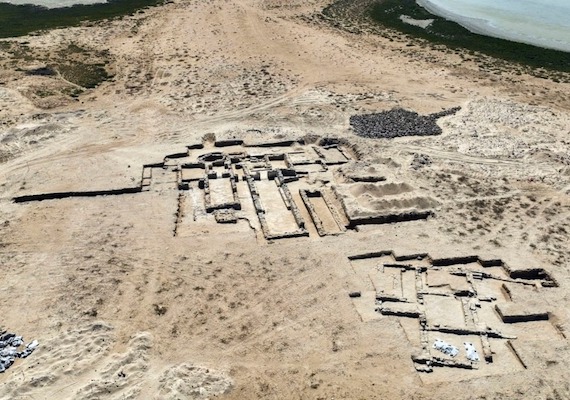
An ancient Christian site has been discovered on an island off the coast of the United Arab Emirates, officials announced recently. The religious complex, a monastery, could date to a time before the spread of Islam across the Arabian Peninsula. The monastery is providing researchers a lot of information about early Christianity in the Persian Gulf area. It is the second such monastery found in the Emirates, dating back as many as 1,400 years. The two monasteries became lost to history in the sands of time. As Islam spread in the area, experts believe Christians slowly became Muslim. Today, Christians remain a minority across the wider Middle East. Timothy Power of the United Arab Emirates University described the UAE today as a “melting pot of nations.” Power helped investigate the newly discovered monastery. He added, “The fact that something similar was happening here ... 1,000 years ago is really remarkable and this is a story that deserves to be told." The monastery sits on Siniyah Island in Umm al-Quwain, an emirate some 50 kilometers northeast of Dubai. The island has a series of sandy areas coming off of it like fingers. On one, to the island’s northeast, researchers discovered the monastery. Samples found in the monastery’s foundation date between 534 and 656. Islam’s Prophet Muhammad was born around 570 and died in 632. Seen from above, the monastery's floor plan suggests early Christian worshippers prayed within a small church. Rooms within the monastery appear to hold a baptismal area, as well as an oven for baking bread or wafers for communion rites. Another area also likely held an altar and an installation for communion wine. Next to the monastery sits a second building with four rooms, likely around an open area known as a courtyard. This was possibly the home of an early church leader such as an abbot or even a bishop.
Today, Christians remain a minority across the wider Middle East.
Middle
Fiddle
Little
Riddle
Where is the newly discovered monastery located?
an island
a mountain
underwater
a jungle
Which of the following is a definition of the word remarkable?
unusual or surprising
regarded by society to be good, proper, or correct
dismissed as inadequate
repeated for clarity