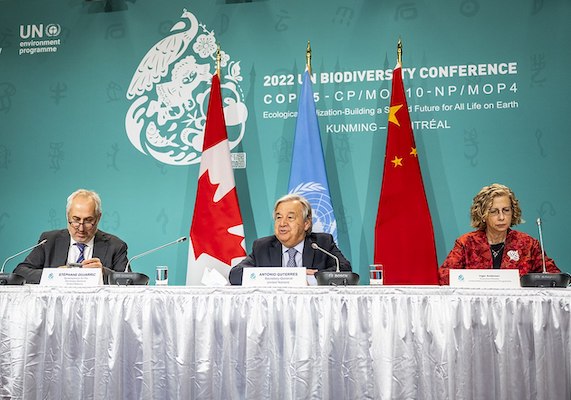
Negotiators at a United Nations environmental conference in Canada reached a historic deal Monday. It aims to protect the world’s lands and oceans and provides financing to save biodiversity in the developing world. The agreement came on the final day of the U.N. Biodiversity Conference, or COP15, in Montreal. China, the president of COP15, offered a proposal Sunday that helped the negotiations move forward. Chinese Environment Minister Huang Runqiu spoke about it to the delegates. He said he believed the deal, in his words, can guide us as we all work together to halt and reverse biodiversity loss and put biodiversity on the path to recovery…. Huang said that would be good for all the world’s peoples. The agreement’s most important term is known as 30 by 30. It is a promise to protect 30 percent of land and water considered important for biodiversity by the year 2030. Currently, such protection covers 17 percent of land. The deal also calls for raising $200 billion by 2030 for biodiversity financing from a number of sources. In addition, another goal is to work to end or change subsidies that could provide another $500 billion for nature. As part of the financing, the deal calls for increasing the money that goes to poor countries to at least $20 billion each year by 2025. That number would increase to $30 billion each year by 2030.
Which of the following is a definition of the word subsidies?
money that is paid usually by a government to keep the price of a product or service low or to help a business or organization to continue to function
a warship with a streamlined hull designed to operate completely submerged in the sea for long periods, equipped with a periscope and typically armed with torpedoes or missiles
a sandwich made of a long roll typically filled with meat, cheese, and vegetables such as lettuce, tomato, and onions
a writ ordering a person to attend a court
Where was the U.N. Biodiversity Conference held?
Montreal
Munich
Mumbai
Mexico City
It is a promise to protect 30 percent of land and water considered important for biodiversity by the year 2030.
water
waiter
waltz
warmup