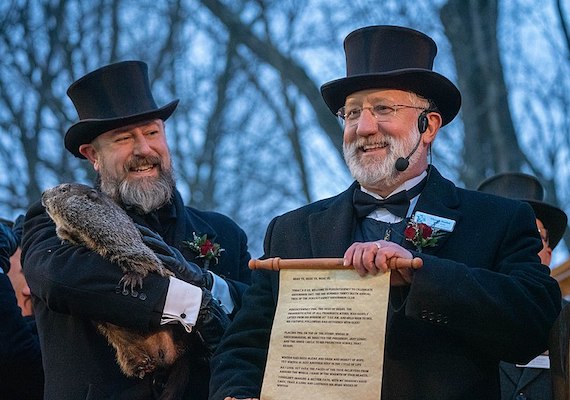
A groundhog from the small town of Punxsutawney in the state of Pennsylvania again predicted that North America would have six more weeks of winter. On Thursday, thousands of people gathered around a hill called Gobbler’s Knob to watch the yearly event. A group of men in black coats and top hats woke up the groundhog from his long winter sleep. It was as if the groundhog, named Punxsutawney Phil, told them, “I see a shadow…It’s six more weeks of winter weather.” Since 1887, tradition says that if Punxsutawney Phil does not see his shadow on Groundhog Day, February 2, spring will come early. Groundhog Day is believed to have come from the ancient European tradition of Candlemas Day. On that day clergy would bless and give out candles to Christians for the long winter. Some versions of the ancient story say that in parts of Germany, people thought that if a hedgehog saw his shadow on Candlemas Day there would be a “Second Winter” or six more weeks of bad weather. As Germans migrated to what is now the state of Pennsylvania, they chose another animal, and Groundhog Day was born.
Which of the following is a definition of the word candle?
a shaped piece of wax with a central wick that is lit to produce light as it burns
a sweet food made with sugar
a device which uses lenses and film to capture an image
a portable shelter made of cloth
If the groundhog sees his shadow, how many more weeks of winter weather should we expect, according to tradition?
six
seven
sixteen
four
A group of men in black coats and top hats woke up the groundhog from his long winter sleep.
hats
cats
brats
rats