Title: Solar Activity Can Affect Communication, Power on Earth

Content: <div id='article-page'><div id='article-content' data-media-url='//news-app-staging.s3.amazonaws.com' data-base-url='//news-app-staging.herokuapp.com' data-sound-name='https://news-app-production.s3.amazonaws.com/articles/356/solar_audio.m4a' data-capture-url='//staging.analytics.lingraphica.com/events/capture_news' data-article-title='Solar Activity Can Affect Communication, Power on Earth' data-article-id='681'><script src='//news-app-staging.herokuapp.com/javascripts/getscripts.js'></script><link rel='stylesheet' href='//news-app-staging.herokuapp.com/stylesheets/article.css' type='text/css' /><div class='article'><p><span data-start-time='0' data-end-time='13750'>Scientists who study the sun watch for sunspots -- violent storms that can affect communications, navigation systems and even electric power stations on Earth.</span> </p><p><span data-start-time='13750' data-end-time='21438'>One of those scientists is Alex Young of the Goddard Space Flight Center in Greenbelt, Maryland. </span> <span data-start-time='21438' data-end-time='30917'>Crews at Goddard are studying the Earth and our solar system for NASA, the National Aeronautics and Space Administration. </span> <span data-start-time='30917' data-end-time='37354'>Mr. Young recently told VOA what the space agency is learning about the sun.</span> </p><p><span data-start-time='37354' data-end-time='43917'>Sunspots are a product of huge electromagnetic storms on the sun. </span> <span data-start-time='43917' data-end-time='50438'>Scientists on Earth are able to observe sunspots eight minutes after they happen. </span> <span data-start-time='50438' data-end-time='54771'>That is how long it takes for the sun&rsquo;s light to reach us.</span> </p><p><span data-start-time='54771' data-end-time='65229'>The first electrically charged particles from a sunspot enter Earth&rsquo;s atmosphere about 20 to 30 minutes after the storm happens. </span> <span data-start-time='65229' data-end-time='68792'>These particles can harm human beings. </span> <span data-start-time='68792' data-end-time='79833'>So before they arrive, astronauts on the International Space Station move into special areas designed to protect them from their effects.</span> </p><p><span data-start-time='79833' data-end-time='85333'>About a day or two later, the biggest part of the storm arrives. </span> <span data-start-time='85333' data-end-time='88792'>It is called a coronal mass ejection.</span> </p><p><span data-start-time='88792' data-end-time='95792'>&ldquo;That is billions of tons of solar material that&rsquo;s blown away from the sun. </span> <span data-start-time='95792' data-end-time='101458'>It&rsquo;s traveling millions of kilometers an hour, but that is relatively slow.&rdquo;</span> <span data-start-time='101458' data-end-time='104042'>That is Alex Young.</span> <span data-start-time='104042' data-end-time='110667'>He is the Associate Director for Science at NASA&rsquo;s Heliophysics Science Division.</span> </p><p><span data-start-time='110667' data-end-time='120354'>Several civilian government agencies and the U.S. Air Force watch weather conditions in space 24 hours a day. </span> <span data-start-time='120354' data-end-time='129104'>NASA does so because it must protect its astronauts and the electronic devices on its spacecraft.</span> </p><p><span data-start-time='129104' data-end-time='141250'>Scientists are also trying to understand why the number of sunspots rises and falls at almost regular intervals every 11 years. </span> <span data-start-time='141250' data-end-time='147396'>In other words, scientists can almost predict the amount of solar activity.</span> </p><p><span data-start-time='147396' data-end-time='152875'>&ldquo;Also, sometimes the intensity is higher, sometimes lower. </span> <span data-start-time='152875' data-end-time='160167'>For example, the current solar cycle, as we call it, that we are in, is much lower than the previous one.&rdquo;</span> <span data-start-time='160167' data-end-time='166250'>Several satellites watch the sun and the environment between the sun and the earth. </span> <span data-start-time='166250' data-end-time='174521'>Pictures and other information from the satellites tell scientists what is happening on and near the sun.</span> </p><p><span data-start-time='174521' data-end-time='183292'>Alex Young says we have only been looking at the sun with powerful instruments for about 30 to 40 years. </span> <span data-start-time='183292' data-end-time='190958'>That is a very short time compared to the four billion years that the star has been shining.</span> </p><p><span data-start-time='190958' data-end-time='192667'>I&rsquo;m Jim Tedder.</span> </p></div><div class='control-buttons-sticky' style='display:none;'><div class='control-buttons'><button title='Back' class='back' disabled='disabled'></button><button title='Play' class='play' disabled='disabled'></button><button title='Pause' class='pause' style='display:none;'></button><button title='Forward' class='forward' disabled='disabled'></button><button class='finished-reading' style='display:none;'>Done</button></div></div></div><div id='article-media'><div id='media-image'><img src='https://news-app-production.s3.amazonaws.com/articles/356/solar_image.jpg'/></div></div><div id='question-content' style='display:none;'><div class='vocabulary_question question-container' data-question-id=3581 data-hint-location='0' style='display:none;'><div class='question' data-sound-name='https://news-app-production.s3.amazonaws.com/articles/356/what_does_navigation_mean.m4a'>What does navigation mean?</div><div class='choices' data-correct-choice='the process of finding the way to get to a place when traveling'><div class='choice' data-sound-name='https://news-app-production.s3.amazonaws.com/articles/356/the_main_idea.m4a'><span>the main idea</span></div><div class='choice' data-sound-name='https://news-app-production.s3.amazonaws.com/articles/356/the_process_of_finding_the_way_to_get_to_a_place_when_traveling.m4a'><span>the process of finding the way to get to a place when traveling</span></div><div class='choice' data-sound-name='https://news-app-production.s3.amazonaws.com/articles/356/a_series_of_events.m4a'><span>a series of events</span></div><div class='choice' data-sound-name='https://news-app-production.s3.amazonaws.com/articles/356/when_compared_to_others.m4a'><span>when compared to others</span></div></div></div><div class='multiple_choice_question question-container' data-question-id=3582 data-hint-location='37354' style='display:none;'><div class='question' data-sound-name='https://news-app-production.s3.amazonaws.com/articles/356/what_are_sunspots.m4a'>What are sunspots?</div><div class='choices' data-correct-choice='storms on the sun'><div class='choice' data-sound-name='https://news-app-production.s3.amazonaws.com/articles/356/sun_damage.m4a'><span>sun damage</span></div><div class='choice' data-sound-name='https://news-app-production.s3.amazonaws.com/articles/356/storms_on_the_sun.m4a'><span>storms on the sun</span></div><div class='choice' data-sound-name='https://news-app-production.s3.amazonaws.com/articles/356/uv_rays.m4a'><span>UV rays</span></div><div class='choice' data-sound-name='https://news-app-production.s3.amazonaws.com/articles/356/sun_burn.m4a'><span>sun burn</span></div></div></div><div class='sentence_completion_question question-container' data-question-id=3583 data-hint-location='120354' style='display:none;'><div class='question' data-sound-name='https://news-app-production.s3.amazonaws.com/articles/356/nasa_keeps_track_of_the_sunspots_to_protect_its__blank__and_the_electronic_devices.m4a'>NASA keeps track of the sunspots to protect its <span class='blank'>astronauts</span> and the electronic devices.</div><div class='choices' data-correct-choice='astronauts'><div class='choice' data-sound-name='https://news-app-production.s3.amazonaws.com/articles/356/astronauts.m4a'><span>astronauts</span></div><div class='choice' data-sound-name='https://news-app-production.s3.amazonaws.com/articles/356/facility.m4a'><span>facility</span></div><div class='choice' data-sound-name='https://news-app-production.s3.amazonaws.com/articles/356/data.m4a'><span>data</span></div><div class='choice' data-sound-name='https://news-app-production.s3.amazonaws.com/articles/356/journey.m4a'><span>journey</span></div></div></div><div class='question-buttons'><button class='skip-button'></button><button class='hint-button'></button><button class='speak-button'></button></div></div></div>

Sound Name: https://news-app-production.s3.amazonaws.com/articles/356/solar_audio.m4a

Preview

Scientists who study the sun watch for sunspots -- violent storms that can affect communications, navigation systems and even electric power stations on Earth.

One of those scientists is Alex Young of the Goddard Space Flight Center in Greenbelt, Maryland. Crews at Goddard are studying the Earth and our solar system for NASA, the National Aeronautics and Space Administration. Mr. Young recently told VOA what the space agency is learning about the sun.

Sunspots are a product of huge electromagnetic storms on the sun. Scientists on Earth are able to observe sunspots eight minutes after they happen. That is how long it takes for the sun’s light to reach us.

The first electrically charged particles from a sunspot enter Earth’s atmosphere about 20 to 30 minutes after the storm happens. These particles can harm human beings. So before they arrive, astronauts on the International Space Station move into special areas designed to protect them from their effects.

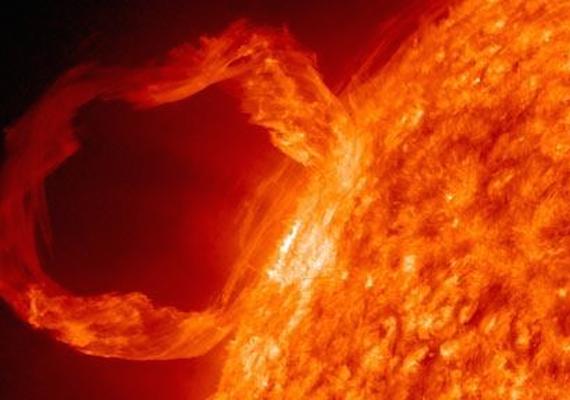
About a day or two later, the biggest part of the storm arrives. It is called a coronal mass ejection.

“That is billions of tons of solar material that’s blown away from the sun. It’s traveling millions of kilometers an hour, but that is relatively slow.” That is Alex Young. He is the Associate Director for Science at NASA’s Heliophysics Science Division.

Several civilian government agencies and the U.S. Air Force watch weather conditions in space 24 hours a day. NASA does so because it must protect its astronauts and the electronic devices on its spacecraft.

Scientists are also trying to understand why the number of sunspots rises and falls at almost regular intervals every 11 years. In other words, scientists can almost predict the amount of solar activity.

“Also, sometimes the intensity is higher, sometimes lower. For example, the current solar cycle, as we call it, that we are in, is much lower than the previous one.” Several satellites watch the sun and the environment between the sun and the earth. Pictures and other information from the satellites tell scientists what is happening on and near the sun.

Alex Young says we have only been looking at the sun with powerful instruments for about 30 to 40 years. That is a very short time compared to the four billion years that the star has been shining.

I’m Jim Tedder.
Edit | Back